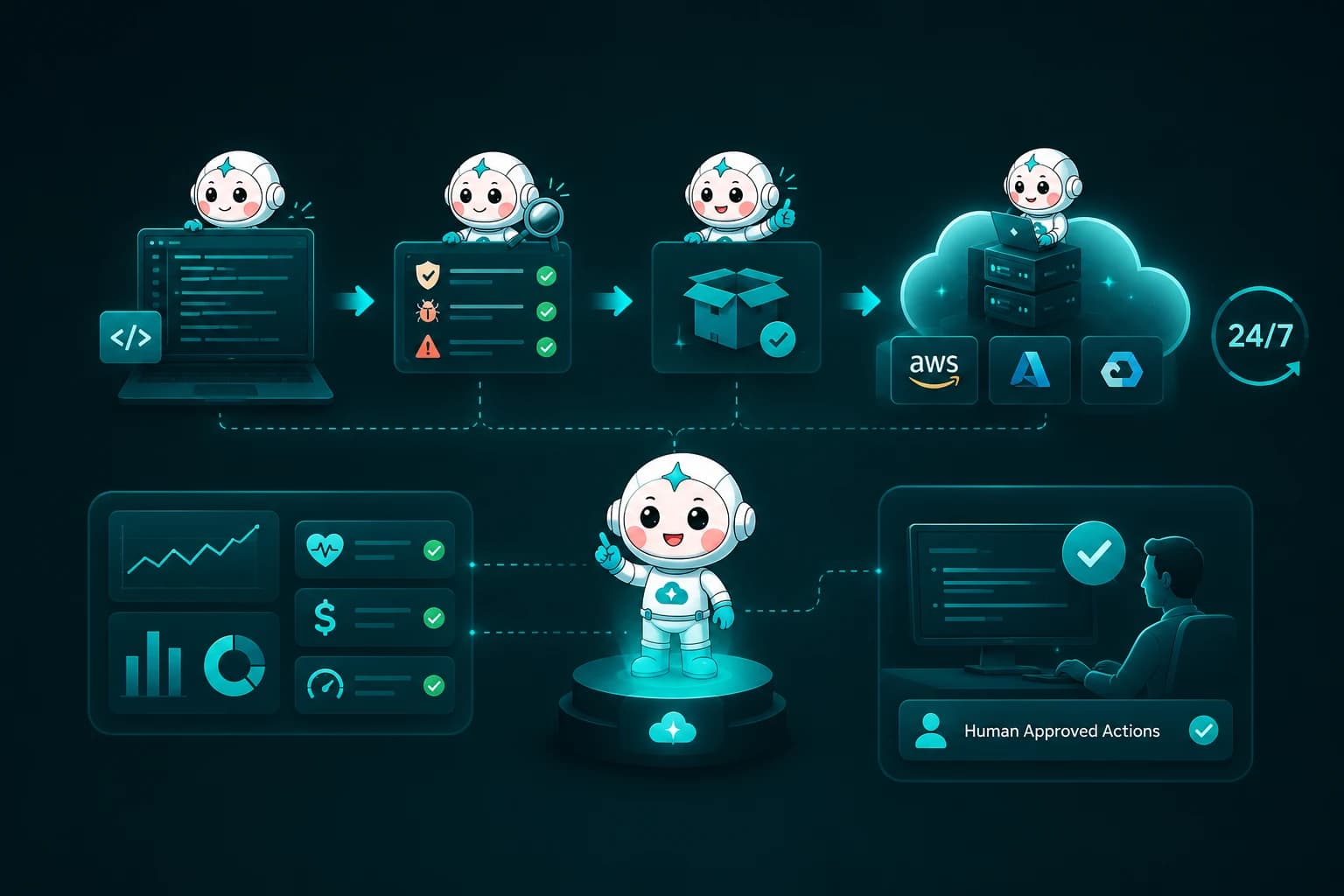
Unifying Your Production Operations Stack with CloudThinker
Coding agents such as Claude Code, OpenAI Codex, Cursor, and Kiro have compressed the software delivery cycle from days to hours. Production operations has not kept pace. The work that follows the merge — cost management, security testing, incident response, code review, and operational automation — remains distributed across one tool per discipline, each with its own credentials, its own data, and its own AI assistant that has no visibility into the others.
A typical stack in 2026 includes a cost dashboard, a security scanner with a periodic penetration test, an incident management platform, a workflow builder for automation glue, a code review bot, and often an internally maintained agent framework. Each tool is reasonable in isolation. The integration between them, however, is performed by engineers — usually the most senior ones, and usually during incidents, when the cost of fragmented context is highest.
This post presents two arguments:
- Automate the operations. The recurring work a production stack demands — cost review, security testing, incident investigation, merge-request gating, scheduled automation — can now be executed by AI agents under human-defined policy.
- Unify the agents. These agents deliver the most value on a single multi-agent platform with shared connections, memory, policy, and audit — not as separate assistants attached to each existing tool.
Where the platform sits
Coding agents own the work up to the merge. An operations platform owns what follows: review, deploy gating, and production. CloudThinker is built around this boundary:
AI factory, coding agents
Hundreds of agents, running in parallel
Plan
Code
Your environment
The disciplines in the second box are not separate products. They are specialized agents operating on a shared foundation, and that distinction — shared runtime versus bundled products — is the basis of the argument that follows.
Automate the operations, not just the code
Most recurring operational work follows a single pattern: observe system state, form a hypothesis, take a governed action, and verify the result. Cost reviews, security tests, incident investigations, and review gates all fit this loop. Until recently, only the observation step was automated; tools surfaced information, and people did the rest.
Coding agents do not close this gap, for structural rather than capability reasons. A coding agent is a development tool: it operates in a workspace, on invocation, with a developer supervising. It does not run continuously against telemetry, hold least-privilege production credentials, enforce approval policy, or produce an audit trail suitable for compliance review. Faster delivery also increases the operational workload — more deployments to monitor, more attack surface to test, more spend to govern, more changes to review. We examine this asymmetry in The future of SDLC: VibeOps with guardrails.
Operations agents close the full loop under policy: detect idle capacity and open a rightsizing change for approval; test each release and verify findings through safe, read-only exploitation before reporting; investigate an alert and keep it open until telemetry confirms recovery; review a change against the incident and cost history of the services it affects. The defining property is not model capability — it is loop closure under governance.
The business impact is direct:
- Engineering capacity. Senior engineering time currently spent coordinating across tools is returned to project work, without hiring.
- Incident cost. Diagnosis typically consumes 40–70% of incident time. Investigation that completes in minutes rather than hours is the difference between a degraded window and an SLA breach.
- Security assurance. Testing that runs per release, rather than annually, surfaces findings while the responsible change is recent and the fix is a same-day merge request.
Unify the agents on one platform
There are two ways to introduce agents into an operations stack: attach one to each existing tool, or run them on a shared foundation. The per-tool approach is the current market default, and it reproduces four known failure modes:
- Context partitioning. The incident agent cannot see the cost tool's recent rightsizing; the security scanner cannot see the review bot's approval. Cross-tool correlation falls back to people. The alternative — agents that share one memory of the system — is what we call AgenticOps.
- Credential sprawl. Every tool with production access is a standing credential, typically broad, long-lived, and rarely reviewed. This is a non-human identity risk before any AI is added; attaching an LLM to each tool's privileged access widens it.
- Ungoverned automation. Ticket-filing flows, report summarizers, and restart jobs accumulate into an undocumented operations layer with no policy engine, no audit trail, and no owner after the author departs.
- Duplicated spend. Each vendor prices its AI assistant separately, and each assistant is confined to that vendor's data. Multiple isolated copilots do not compose into one operator that can carry a task from alert to verified resolution.
These failure modes map to measurable costs: outage minutes, breach exposure and audit effort, key-person risk, and AI spend that never compounds.
A unified platform is defined by what is shared:
- One connection layer. Cloud, clusters, observability, source control, and on-call systems are integrated once through governed connections with brokered credentials. Agents receive scoped, short-lived access per task.
- One memory. Investigations, cost decisions, security findings, and review history persist in a shared store available to every agent.
- One policy and autonomy layer. Graduated autonomy — Notify, Suggest, Act-with-Approval, Autonomous — is set per agent and per environment, enforced through policy-as-code.
- One audit trail. Every agent action is recorded in a tamper-evident log suitable for compliance review and post-incident reconstruction.
- Specialized agents on top. Cost, security, incident, review, and custom agents operate as roles on this foundation rather than as separately integrated products.
CloudThinker implements this architecture. Each capability in the diagram above — review, deploy gating, incident resolution, cost management, and scheduled automation — runs on the same connections, memory, policy engine, and audit log. Adding a discipline means enabling an agent, not integrating another system.
The security model is the precondition
Consolidation concentrates capability, so the security architecture determines whether the approach is viable in production. The requirements:
- Brokered, short-lived credentials. Agents never hold raw keys. Access is scoped per task, centrally revocable, and reviewed in one place.
- Policy-as-code evaluated before action. Permitted actions, environments, and approval requirements are declared and versioned.
- Graduated autonomy per environment. Autonomous in development, approval-gated in production, notify-only where trust is still being established. See human-in-the-loop vs human-on-the-loop.
- Tamper-evident audit. Every action is recorded in a form that satisfies SOC 2 and equivalent regimes.
- Bounded blast radius. Execution is sandboxed so that an agent error is a contained event, not an outage. See What is agent blast radius?
Under this model, consolidation reduces attack surface relative to sprawl: one governed runtime with brokered credentials presents less standing exposure than several tools holding long-lived production access under independent guardrail designs.
What shared context delivers
The operational benefit of unification is that context accumulates across domains. Consider a routine sequence: the cost agent rightsizes a staging node group and records the rationale. The next day, a deployment raises p99 latency. The incident agent's first hypothesis — a capacity change — is confirmed or eliminated in seconds, because the rightsizing decision is in shared memory alongside the deployment diff and its review verdict. The fix ships, validation confirms recovery, and the next security assessment starts from the service's current topology.
On a fragmented stack, the same sequence requires hours of cross-dashboard correlation, frequently ends with the rightsizing reverted as a precaution, and leaves the next security assessment to rediscover the topology independently. The difference is measured in engineer-hours, cloud spend, and customer-facing minutes. We analyze this effect in The compounding value of connected operations.
Customer results
Two published case studies illustrate the approach in production. As with any deployment data, outcomes depend on the environment and starting operational maturity.
F88, one of Vietnam's largest consumer-finance companies — millions of customers, more than 800 branches, and a hybrid AWS and on-premises estate — began with a limited read-only pilot and expanded scope as accuracy was demonstrated. Current results: 80% of daily manual operations automated, a 30% reduction in AWS spend through continuous optimization, 24/7 agent monitoring across critical lending applications, and incident root-cause analysis reduced from days to minutes.
Diaflow, a global AI SaaS platform, adopted the platform under compliance and growth requirements: SOC 2 and HIPAA mandates, cost control at global scale, and a 99.9% uptime target. Results: three-region infrastructure deployed in four weeks, SOC 2 / HIPAA / GDPR compliance readiness in three weeks, an 80% reduction in operational task load, and 99.9% uptime sustained and verified.
Both deployments followed the same trajectory: automate the existing operational workload first, run the agents on one platform, and widen autonomy as measured accuracy justifies it.
A staged adoption path
Replacing an operations stack in a single program is not advisable. The sequence that works in practice:
- Start in the domain with the clearest need — incidents, cost, or security. Connect the first agent in notify-only mode and measure its accuracy before granting write access.
- Add the adjacent domain. The first cross-domain result — an incident investigation citing a cost change, or review context shortening a diagnosis — is concrete evidence that shared context is producing value.
- Migrate the automation glue. Move production-touching flows and scheduled jobs into governed operation tasks, retiring their standing credentials. The /automate catalog covers common patterns.
- Extend with custom agents for organization-specific operations — compliance evidence collection, migration runbooks, capacity reviews — using custom agents and skills, which inherit the platform's memory, policy, and audit.
Each step is independently justifiable; completed in sequence, they replace the fragmented stack.
FAQ
Is a single platform a single point of failure? Concentration risk should be weighed against the alternative: several tools with standing production access and independent guardrail designs. A consolidated runtime with brokered credentials, policy-as-code, graduated autonomy, and tamper-evident audit presents a smaller and better-instrumented failure domain.
Does adoption require replacing existing tools immediately? No. Observability, on-call, and source control remain in place; the platform connects to them. Adoption starts with one domain in notify-only mode and expands as accuracy is demonstrated.
Can this be built with a workflow builder and an LLM? For non-production automation, a workflow builder is a reasonable choice. It does not provide cross-domain memory, brokered credentials, policy enforcement, autonomy controls, or audit — building those is a multi-year platform-engineering effort, analyzed in Build vs Buy: The 24-Month TCO of an Agentic Operations Platform.
Are coding agents sufficient? Coding agents and an operations platform are complementary. Development agents do not monitor telemetry, hold governed production access, or operate under operational policy — and the faster they accelerate delivery, the larger the operational workload they create.
Where does CloudThinker run? SaaS by default, with sovereign deployment options for BFSI, government, and data-residency-constrained environments. See SaaS vs Sovereign AI SRE.
The platform overview documents the shared foundation in detail. To discuss a starting domain for your environment, contact us.