AI is finally ready to take the night shift.
An on-call team that doesn't sleep — a team of specialist agents that detect, analyze, resolve, and validate production incidents. Every action logged. Every incident makes them smarter.
- Resolve incidents faster
- Page on incidents, not noise
- Every action logged and reversible


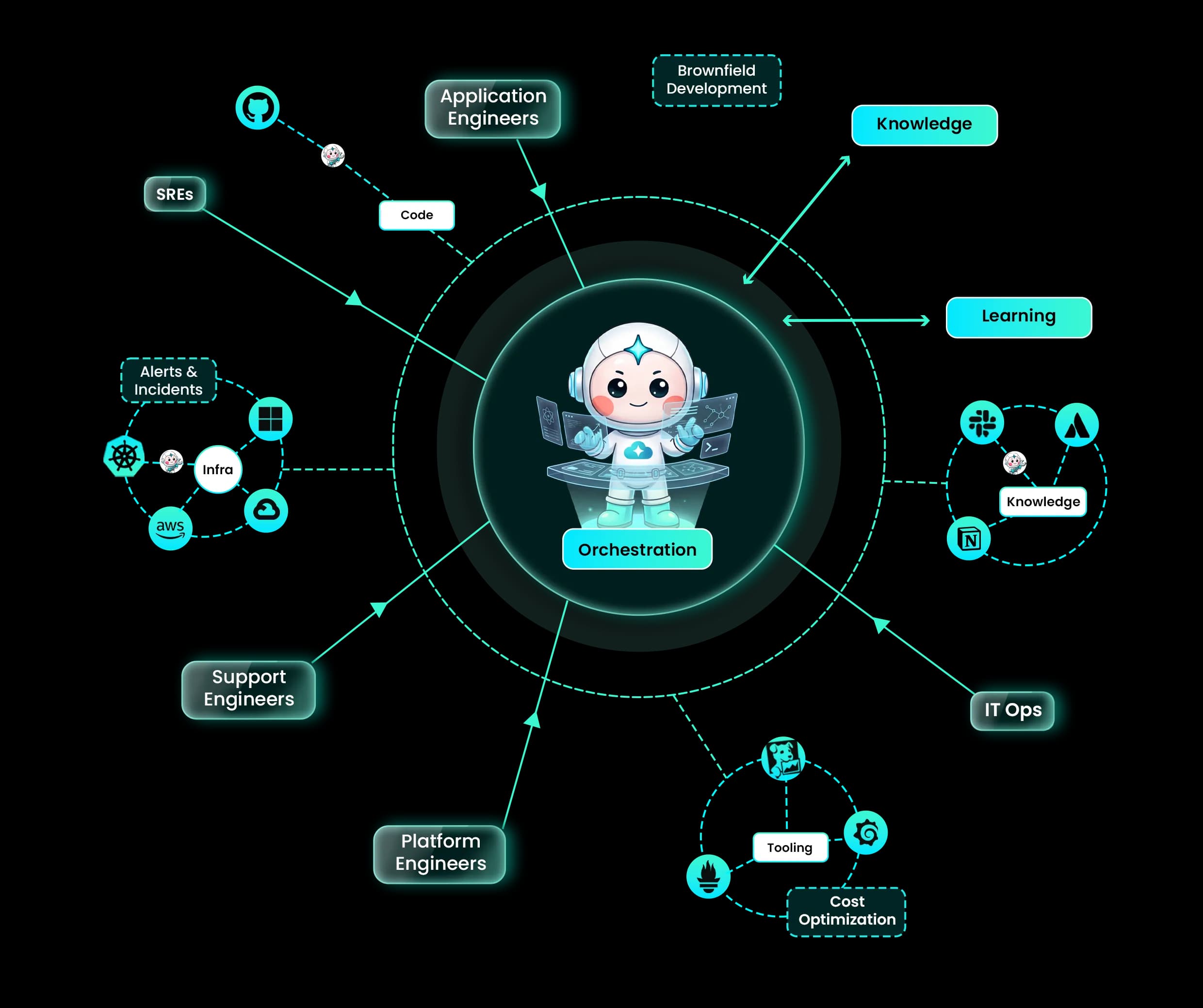
Most teams still wake their engineers at 2am for problems an AI should handle.
Less paging. More closed loops.
Numbers from design-partner production traffic over the last 90 days, plus one public benchmark we ran ourselves. Trusted by teams running real customer load on AWS and GCP.
Pulse compresses raw noise into the few signals worth waking for.
Across closed P2/P3 incidents on design-partner production traffic.
Median time-to-mitigate, measured against the prior on-call rotation.
Self-run on the SREGym-Lite cohort with GPT-6 Astra. Every fault diagnosed, every gradable fault fixed. The best public leaderboard row closes 81%.
Read the evaluationDRE closed three P2s while my team slept. The post-mortems were waiting in Slack at 8am with the runbook already written. That used to be a half-day for a senior engineer.
 Resolved byManager Engineer
It promoted a read replica at 3am because the primary was thrashing. Validated the failover, wrote the runbook, paged me only to confirm. That was the moment I trusted it.
 Resolved byDatabase Engineer
We cut our 2am pages by more than half in the first month. The on-call rotation finally stopped feeling like a punishment.
 Resolved bySecurity Engineer
The audit trail is what got it past our security review. Every action, every privilege, every outcome — replayable. No other AI SRE tool came close.
 Resolved byKubernetes Engineer
Pulse plus Resolver, run by the DARV pipeline.
Most “AI SRE” tools stop at seeing — they detect, investigate, recommend, then hand the problem back to a human. DRE closes the loop end-to-end.
- 08:43:025xx rate 18% on /checkout
- 08:43:01payments-db-prod CPU 97%
- 08:42:58checkout-svc p99 latency 3.1s
- 08:42:55orders-worker retries climbing
- 08:42:49paged @on-call
Five specialists. One on-call team.
Each agent owns a domain. They coordinate like a real on-call rotation — except they don't sleep, every action is logged, and they get smarter with every incident.

Cloud Engineer
Cloud Engineer
Reads the codebase. Finds the bug, the regression, the bad deploy.
git revert <bad-sha>Kubernetes Engineer
Kubernetes Engineer
Watches access, secrets, and audit. Flags anything that smells like an incident in disguise.
rotate keyManager Engineer
Manager Engineer
The on-call lead. Routes the incident, runs the playbook, signs the post-mortem.
route the incidentSecurity Engineer
Security Engineer
Owns the wires. Routes, DNS, load balancers, capacity, blast radius.
failover regionDatabase Engineer
Database Engineer
Queries, locks, replication, schema. The slow-query whisperer.
promote replicaThe substrate that closes the loop.
DARV is the pipeline. These are the things that make every next incident faster, cheaper, and safer than the last.
A shared brain across incidents. Every resolution becomes a private skill the next agent applies — your runbook, not the public internet.
Written by the agent that fixed it. Timeline, root cause, action, validation — published the moment the incident closes. The next on-call replays them automatically.
Every action logged. Who did what, when, with what privilege, with what outcome. Compliant by construction, replayable on demand.
They see. We act. We learn.
Detection without action is just a louder pager. Here's where DRE goes further than the rest of the category.
| Capability | DRE | Most “AI SRE” tools |
|---|---|---|
| Detect anomalies | ||
| Analyze root cause | ||
| Recommend a fix | ||
| Execute the fix autonomously | human-in-loop | |
| Validate that the fix worked | ||
| Coordinated multi-specialist team | single-agent | |
| Full audit trail per action | varies | |
| Per-agent domain memory | generic embeddings | |
| Auto-generated runbooks |
Start with AWS support and a CloudThinker FDE.See ROI on day one.
Your AWS agreement and credits carry straight over, and a CloudThinker forward deployed engineer does the onboarding, so the first result lands on day one.

Up to $200K in AWS credits
Applied to your own AWS account.
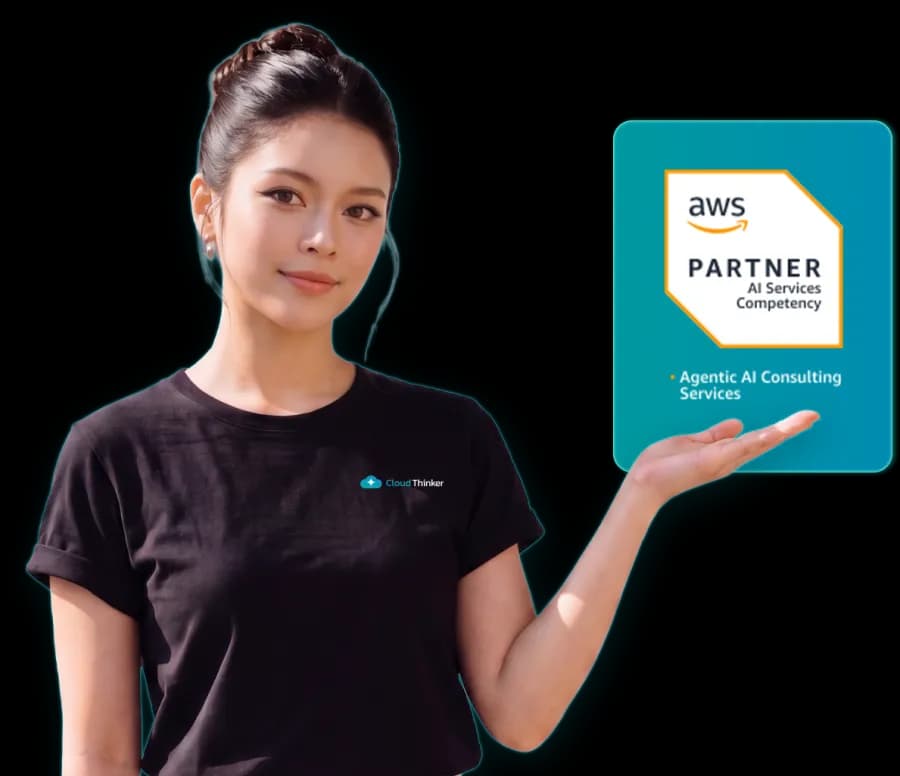
AWS AI Services Competency
Validated for Agentic AI Consulting.
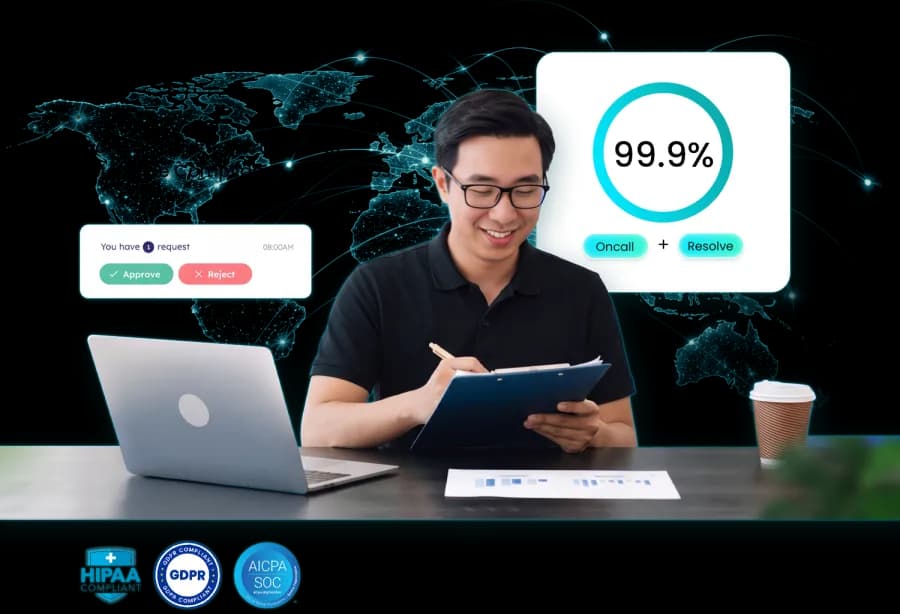
Covered 24/7, on your approval
Under HIPAA, GDPR and SOC 2 controls.