Introducing Deep Response Engine
Most platforms tell you something is wrong. CloudThinker tells you why — and starts fixing it before you open your laptop.
The 3 AM Problem, Revisited
Three months ago we shipped CloudThinker Incidents. The premise was simple: AI investigates, humans validate. From a 45-minute hunt to a sub-10-minute resolution.
It worked. But we kept seeing the same gap upstream of it.
It's 3:14 AM. A page fires. By the time it lands on a phone, your monitoring stack has already produced a few thousand events that night — most duplicates, most internal AWS bookkeeping, most flapping resources. The on-call engineer has to triage which alert, of all of them, is the one that woke them up. Investigation can't even begin until that triage is done.
The signal-to-noise problem isn't an investigation problem. It's a layer earlier. And it was the one CloudThinker Incidents alone couldn't solve.
So we built it.
Today we're announcing Deep Response Engine — CloudThinker's end-to-end response loop. It's a rename and an expansion. What used to be Incidents is now one of two pillars under a single module: signal intelligence and AI investigation, joined by an explicit memory layer, designed to operate as one system from the first event in your cloud to a resolved incident with a remediation log.
Two Pillars. One Loop. No Handoff.
Deep Response Engine has two named pillars. Each one stands on its own. Together, they close the loop.
Pulse
Signal Intelligence
- 10+ unified sources
- 7 suppression layers, 98% noise removed
- AI severity + actionability
Incident
Investigation to Resolution
- Hypothesis-driven RCA
- Approval-gated runbooks
- Memory that teaches the next one
A cluster in Pulse becomes an incident in Incident the moment it crosses the actionability bar. Investigation begins automatically. When the root cause is confirmed, the remediation step is searched, surfaced, and (with your approval gates intact) executed. Every resolution feeds Memory. The next similar incident benefits.
No tickets. No copy-pasting between tools. No human in the middle of the routine work.
Pillar 01 — Pulse
Most tools detect. Pulse decides what's worth waking you for.
Your monitoring stack is already catching anomalies. CloudTrail flags a security event. GuardDuty detects unusual API access. Datadog notices a latency spike. Slack pings you about an EC2 instance flapping. The problem isn't detection — it's volume. Engineers spend more time triaging noise than fixing real problems.
Pulse sits in front of all of it.
A typical Pulse feed, in one night
Cloud events streaming in from 10+ connected sources
After deduplication and seven suppression layers
Correlated, AI-classified, ready for human attention
It's an 8-stage pipeline, fully automatic.
Pulse — 8-stage pipeline
Cloud event → Routed cluster, fully automatic
Critical, High, or AI-actionable clusters auto-escalate to Incident.
What this gives you in practice:
- 10+ sources, one feed. AWS (CloudTrail, GuardDuty, Cost Anomaly, Health, Config, Access Analyzer), Slack, Teams, Datadog, Grafana, New Relic, PagerDuty, Prometheus, plus generic webhooks. All unified, all normalized.
- Seven suppression layers. Deduplication, rate limiting, flapping detection, cascade silencing, noise signatures, snooze, severity normalization. Stacked, not toggled.
- Auto-correlation into clusters. Nine EC2 alerts about the same node pool become one cluster — not nine pages.
- AI classification on every signal. Category, canonical severity, and an actionability verdict. No manual triage rules.
- One-click escalation. Any cluster escalates to a full incident in one click. Critical, High, or AI-actionable signals escalate automatically.
No rules. No thresholds. No manual tuning.
Pulse learns what matters from the signals themselves. The seven suppression layers stack; the AI classifier learns from your environment. The engineer's job is to look at clusters, not configure filters.
Pillar 02 — Incident
From the moment a cluster escalates, the AI is already investigating.
If you've used CloudThinker Incidents, the foundation is the same — and stronger now. Four named capabilities define how Incident works inside Deep Response Engine.
Hypothesis-Driven RCA
Theories, tested against evidence. Confidence-scored.
Transparent Reasoning
No black box. Every step visible, live.
Automated Remediation
Runbooks executed under your approval gates.
Memory
Every resolution teaches the next.
This is the upgrade most teams feel hardest by month two. The first incident is fast. The hundredth one is almost free.
The Lifecycle, End to End
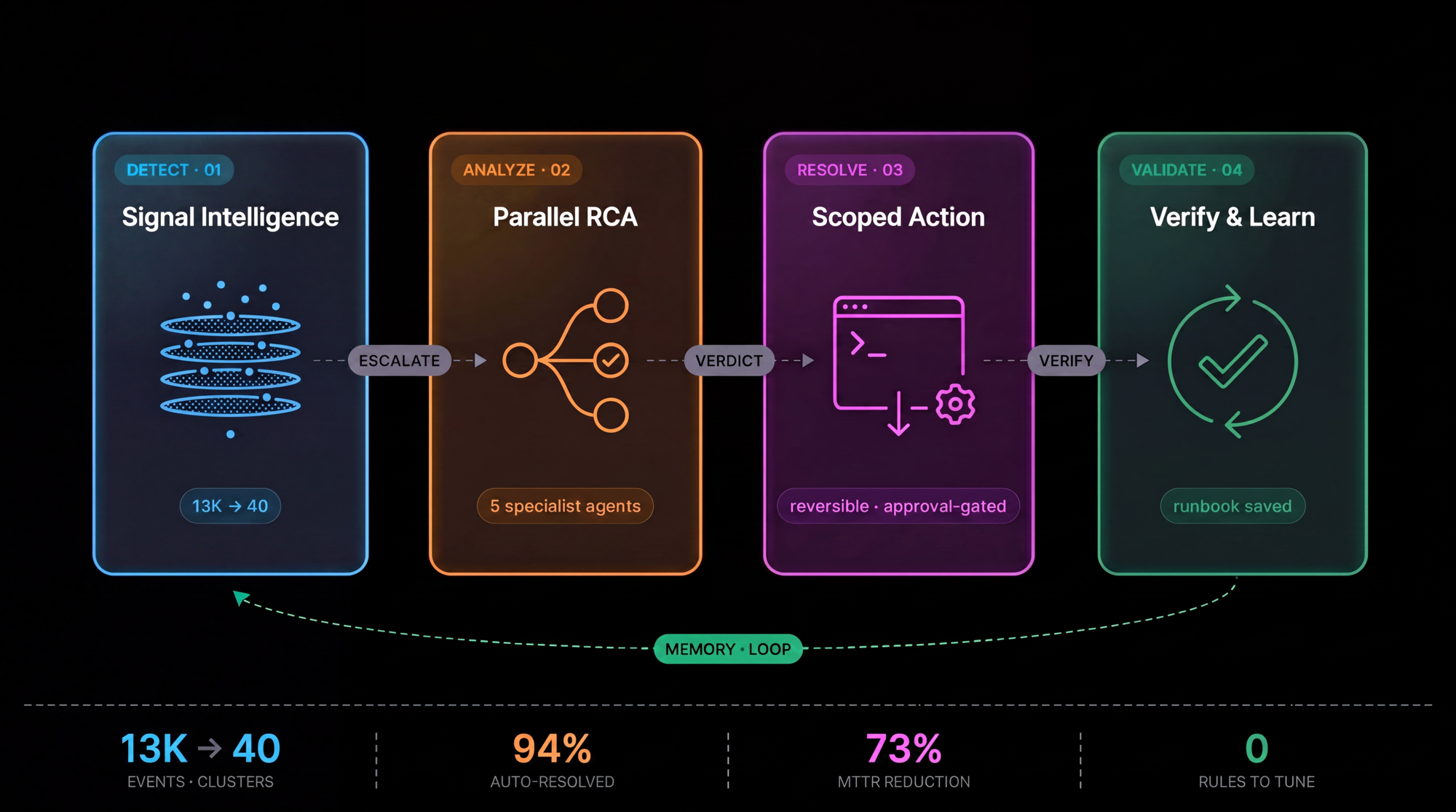
What does this actually look like when it runs?
A signal arrives in Pulse. It is normalized, deduplicated, run through the seven suppression layers, persisted, correlated into a cluster with related signals from the same blast radius, and AI-classified for category, severity, and actionability. If it's Critical, High, or AI-actionable, it escalates.
Incident takes over.
Phase 1 — Context gathering. The AI maps affected services through your topology, pulls metrics from CloudWatch, Prometheus, and Datadog, compares them to baseline, and identifies recent deployments and config changes.
Phase 2 — Analysis & hypothesis testing. Competing theories are formed. Evidence is collected. Theories are ruled out as evidence contradicts them.
Phase 3 — Resolution.
The winning hypothesis is confirmed. Strongest evidence is curated. Remediation steps are generated. A disposition is set: IDENTIFIED, NOT_FOUND, FALSE_ALARM, or ON_HOLD.
Specialized agents work in parallel:
- Anna — coordinates the investigation
- Alex — handles cloud and AWS
- Tony — owns databases
- Kai — owns Kubernetes
- Oliver — covers security and IAM
What used to take a four-hour cross-team sequential investigation now happens in two to ten minutes, in parallel.
When it's resolved, Memory captures the lesson.
What Shipped Today
Three things are new in this release that change how Deep Response Engine feels in production.
Auto-RCA
Investigation starts itself.
Incident Memory
Every resolution, retrievable.
Hardened webhooks
15+ platforms, wire it once.
What's Different From Everything Else
We've been direct about this in every conversation with prospects, so we'll be direct here.
| Aspect | What other tools do | What Deep Response Engine does |
|---|---|---|
| Alert volume | Detect events, flood you with all of them | Suppress 98% of noise before paging |
| Routing | Wake on-call for noise too | Page only Critical / High / AI-actionable clusters |
| Correlation | Group duplicates and stop | Form hypotheses, test them, score the answer |
| Investigation | Show data, humans investigate | AI investigates in parallel across cloud, db, k8s, security |
| Timing | Post-mortem tooling for after the fire | Real-time investigation before a human opens a laptop |
| Knowledge | Leaves with employees | Memory persists; future incidents resolve faster |
| Source sync | One-way alert ingestion | Bidirectional sync with the source platform |
AI as investigator, human as decision-maker, system as long-term memory.
We're not improving the old model. We're proposing a new one. Pulse decides what's worth waking you for. Incident investigates the moment it lands. Memory makes the next one faster.
Getting Started
Deep Response Engine is available today for all CloudThinker customers. If you already use CloudThinker Incidents, you already have it — Pulse, Memory, and the new automation features are now part of the same module under a clearer name and a reorganized navigation.
Setup takes minutes:
- Open Deep Response Engine in your CloudThinker dashboard.
- Connect a Pulse source — AWS, Slack, Datadog, or one of the 15+ webhook integrations.
- Let it run in shadow mode for a day. Watch the noise reduction.
- Configure your runbook library and approval policies.
- Flip the auto-escalation switch.
That's it. The next signal that lands triggers the loop end-to-end.
The Bottom Line
Incident management has been stuck in the same paradigm for too long: humans doing detective work while tools display data, and a flood of alerts on top of it that buries the actual signal.
Deep Response Engine inverts that model. Pulse decides what's worth waking you for. Incident investigates the moment it lands. Memory makes the next one faster.
Your 3 AM self will thank you.
Ready to see it run on your stack?
Deep Response Engine is available now for all CloudThinker platform customers. Contact your account team or visit our documentation to begin setup.